
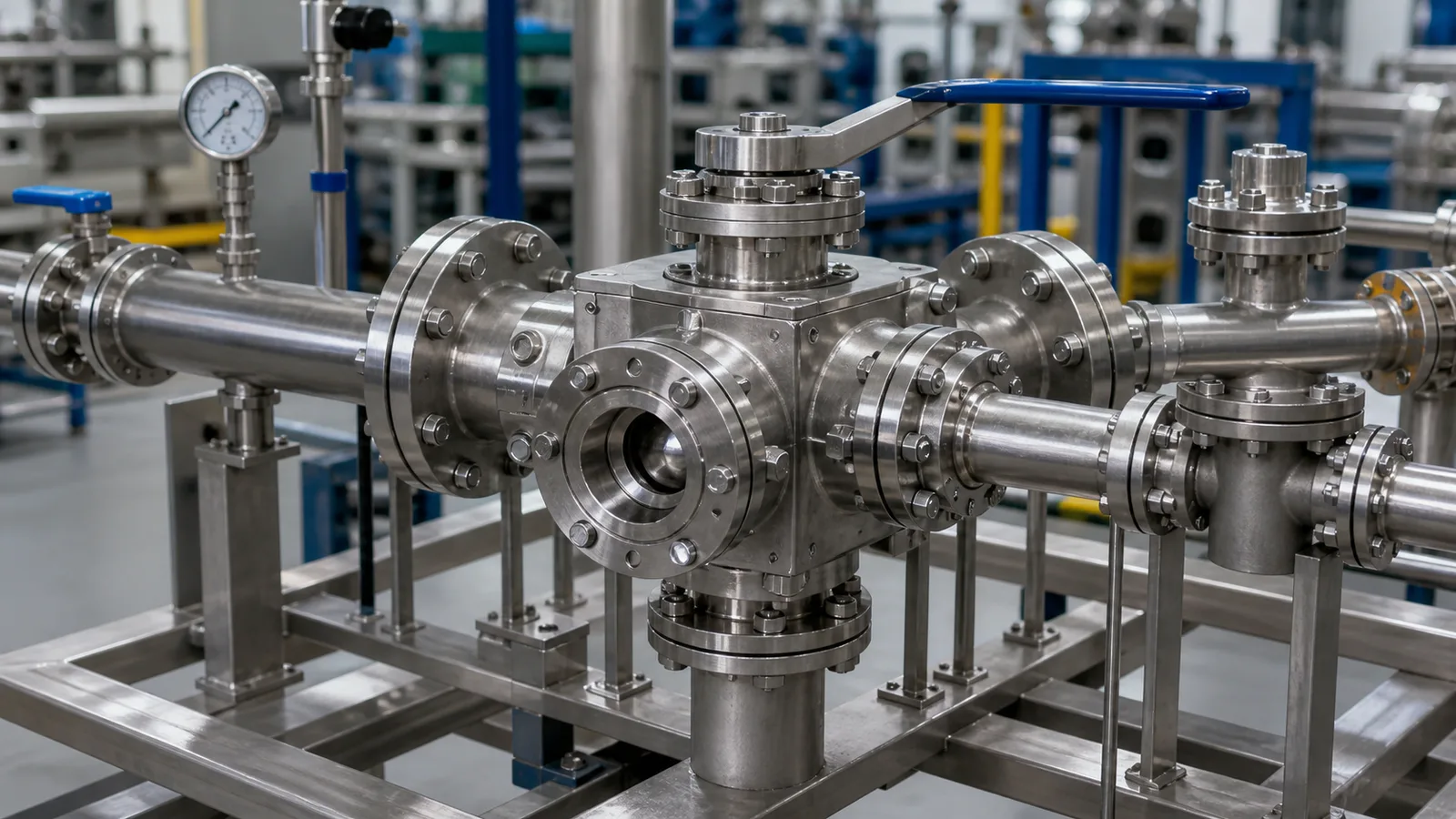
Multi-port ball valves help simplify piping layouts when a system needs to divert, mix, or switch flow between different lines. Instead of installing several two-way valves, a 3-way or 4-way ball valve can control multiple flow paths in a compact body.
For buyers and engineers, the key is to choose the correct port design, connection type, material, seat structure, and operating method. A multi-port valve that looks correct on a drawing may still fail in service if the flow path or sealing requirement is misunderstood.
What Is a 3-Way Ball Valve?
A 3-way ball valve has three ports and is commonly used to divert flow from one line to another, mix two flows into one outlet, or isolate one branch while another remains open. The internal ball can be designed with an L-port or T-port flow path.
An L-port is often used for switching flow between two outlets. A T-port can support mixing, splitting, or more flexible flow arrangements depending on the handle position and valve design.
XIAOVALVE provides 3-way and 4-way ball valve options for industrial multi-port flow control.
What Is a 4-Way Ball Valve?
A 4-way ball valve has four ports and is used where flow needs to be redirected between multiple pipeline directions. It can help reduce piping complexity in systems that require flow reversal, selection between circuits, or switching between process lines.
Compared with using several separate valves, a 4-way valve can reduce installation space and simplify operation. However, the application must be reviewed carefully because not every 4-way design provides the same sealing or flow pattern.
L-Port vs. T-Port Selection
The choice between L-port and T-port is one of the most important decisions for a 3-way valve. An L-port usually allows flow to turn 90 degrees from the inlet to one of two outlets. This makes it practical for flow diversion.
A T-port can connect more than two ports in some positions, making it useful for mixing or distributing flow. Before ordering, engineers should confirm every handle position and verify which ports are open, closed, or connected.
Where Multi-Port Ball Valves Are Used
3-way and 4-way ball valves are used in chemical processing, water treatment, oil and gas skids, fuel systems, HVAC equipment, tank switching systems, and industrial process lines. They are especially useful where compact installation and repeatable flow switching are required.
For smaller threaded applications, buyers may compare NPT and SW ball valves. For larger pipeline systems, flanged multi-port designs may be more suitable.
Material and Seat Considerations
Material selection depends on pressure, temperature, media, corrosion risk, and cleaning requirements. Stainless steel is commonly selected for corrosion resistance, while carbon steel can be suitable for many general industrial services.
Seat material also affects sealing and torque. Clean service may use soft seats, while high temperature or abrasive media may require a metal seated ball valve approach or special seat materials.
Specification Checklist for Buyers
Before purchasing a 3-way or 4-way ball valve, confirm the flow diagram, port type, pressure class, connection standard, body material, seat material, operation method, leakage requirement, and installation orientation.
It is also useful to provide a simple flow schematic during quotation. This reduces the risk of selecting the wrong ball port pattern or handle position arrangement.
For custom multi-port valve selection, buyers can review XIAOVALVE’s ball valve product range or contact the team through the contact page.
Conclusion
3-way and 4-way ball valves can simplify piping systems and improve flow control when selected correctly. The most important step is to match the valve’s internal flow path to the actual process requirement.
By confirming port pattern, material, seat design, and operating conditions before purchase, buyers can avoid flow-routing errors and improve long-term valve reliability.
Recent Comments